×

The Standard e-Paper
Informed Minds Prefer The Standard





Audio By Vocalize
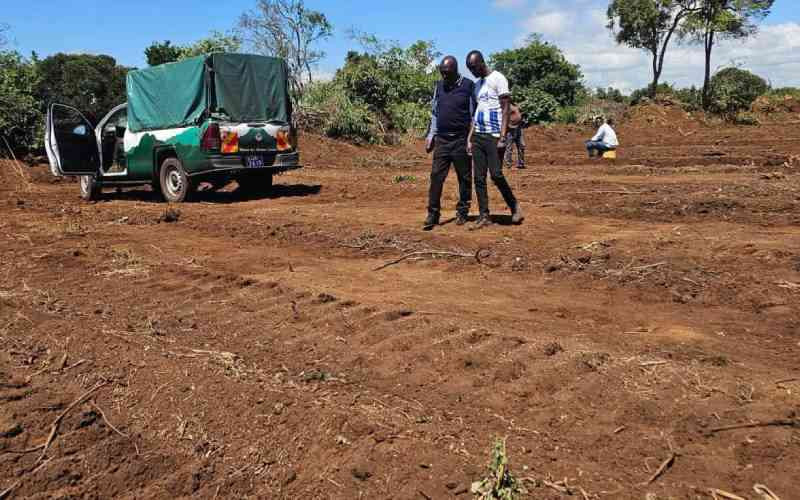
At Kithoka on the edge of Upper Imenti Forest, more than 20 armed officers from the Kenya Forest Service stood guard, controlling entry into the dense montane ecosystem that forms part of the Mt Kenya water tower. The unusually heavy presence underscored growing tension around a proposed airstrip project that conservationists say could alter one of Kenya’s most sensitive ecological zones.
The officers’ deployment comes amid rising concern over reported development activities inside Upper Imenti Forest Reserve in Meru County, where conservation stakeholders warn that infrastructure expansion could disrupt wildlife corridors, water catchment functions and long-term ecosystem stability.
The proposed airstrip, according to conservation groups, sits within a landscape that is not only ecologically fragile but also strategically connected to the wider Mt Kenya ecosystem, a system that feeds two of Kenya’s most important river basins, the Tana and Ewaso Nyiro.
Upper Imenti Forest is not an isolated block. It forms part of a continuous ecological network within the Mt Kenya landscape, linking highland forests to northern rangelands and enabling seasonal wildlife movement across central Kenya. Conservationists say this connectivity is critical for biodiversity survival and water regulation, yet increasingly threatened by infrastructure expansion.
At the centre of the concern is the proposed airstrip, which stakeholders argue could fragment habitats that have taken decades to stabilise under conservation management.
Rhino Ark Kenya Charitable Trust has raised the strongest concerns, warning that the project could undermine ecological integrity in a forest that plays a key role in maintaining wildlife corridors and water systems.
According to the organisation, Upper Imenti supports seasonal elephant movement and acts as a transition zone linking Mt Kenya forests with northern conservation landscapes such as Shaba and surrounding conservancies. Wildlife data shows the broader Mt Kenya ecosystem supports between 1,900 and 2,600 elephants, many of which rely on uninterrupted forest cover during dry seasons.
The organisation argues that disrupting this landscape could increase human–wildlife conflict, reduce genetic diversity, and weaken long-term population resilience.
Upper Imenti sits along a critical hydrological divide between the Tana and Ewaso Nyiro river basins, systems that sustain millions of Kenyans. The Tana River system supports hydropower generation, irrigation schemes, and urban water supply, while the Ewaso Nyiro basin is vital for pastoral livelihoods in northern Kenya, where water scarcity is chronic.
Conservationists warn that altering land use in such a zone risks destabilising downstream water flows and weakening Kenya’s broader water security framework. Upper and Lower Imenti Forest Reserves together cover more than 12,800 hectares, forming a buffer zone that regulates ecological balance between human settlements and the core Mt Kenya forest.
Scientists further emphasise that elephants play a critical ecological role within this system. By opening pathways through dense vegetation, dispersing seeds, and influencing plant regeneration, elephants contribute to forest structure and carbon storage, functions increasingly recognised as part of natural climate regulation systems.
Rhino Ark Executive Director Christian Lambrechts says the proposed development raises serious legal and environmental concerns.
“We are deeply concerned that construction is taking place in a protected forest area without proper environmental procedures being followed,” he said. “No Environmental and Social Impact Assessment has been undertaken, there has been no public participation, and no licence has been issued by the National Environment Management Authority. This raises serious questions about compliance with the law.”
The claims could not be independently verified, and neither the National Environment Management Authority (NEMA) nor the Kenya Forest Service had issued a public response at the time of publication.
Mt Kenya’s forest system is internationally recognised for its biodiversity value, hosting more than 880 plant species, including 81 endemic species found nowhere else in the world. It also supports threatened wildlife such as elephants, bongos, leopards and colobus monkeys, alongside a rich diversity of highland bird species.
Beyond biodiversity, the ecosystem plays a national development role by regulating water systems that sustain energy production, agriculture, and domestic supply. The Tana River basin supports major hydroelectric dams that contribute significantly to Kenya’s national grid, while the same system sustains irrigation schemes and urban water networks.
The Ewaso Nyiro basin supports pastoral economies in northern Kenya, where river flows are often the only reliable water source for livestock and communities.
Rhino Ark has questioned whether alternative infrastructure sites were adequately considered before the proposed development inside the forest. It points to Gaitu Airstrip, located approximately 14 kilometres from Meru Town, as a potential alternative that could be upgraded instead of constructing a new facility within a sensitive ecosystem.
From a conservation perspective, upgrading existing infrastructure outside the forest would achieve development goals without compromising ecological integrity.
Rhino Ark says it has invested more than Sh1 billion over 14 years in conservation work within the Mt Kenya ecosystem, including the construction of 320 kilometres of electric fencing aimed at reducing human–wildlife conflict, with 54 kilometres covering Upper and Lower Imenti forests.
The fencing has significantly reduced crop destruction and improved containment of elephant movement. However, the organisation warns that any disruption to forest integrity could reverse these gains.
Human–wildlife conflict remains persistent in areas surrounding Mt Kenya forests, with an average of about five human fatalities caused by elephants every five years in some zones.
Rhino Ark has also introduced technological interventions, including a virtual elephant grid at Nchoroiboro, designed to improve early warning systems and track elephant movement to reduce conflict incidents.
The organisation further argues that the proposed development may conflict with Kenya’s Vision 2030 framework, the National Climate Change Action Plan, and the National Spatial Plan. It also cites international commitments under the Sustainable Development Goals, the Paris Climate Agreement, and the Convention on Biological Diversity.
“The proposed airstrip is inconsistent with Kenya’s commitments under SDG 6, SDG 13 and SDG 15,” Lambrechts said. “Protecting Upper Imenti is part of safeguarding Kenya’s water towers, wildlife habitats and ecological systems that underpin climate resilience and national development.”
Subscribe to our newsletter and stay updated on the latest developments and special offers!